Q4 2026 update · Updated Nov. 16, 2026 · Latest data: October 2026 (Statistics Canada)
Every holiday has a cost, and it lands on the same budget as everything else. This calendar shows when each gift-giving holiday falls, what people typically spend, when to start saving and what to count. The winter season, from Black Friday through Boxing Week to the January card bills, has its own week-by-week plan with this year's Canada Post cutoffs and return deadlines. To decide how much you can afford, start with how to make a holiday budget.
Quick answer. Start saving about 10 weeks before each holiday, or right after the holidays for next winter: $25.10 a week covers the average $1,305 holiday plan (Deloitte Canada, 2026). This season, Black Friday is Nov. 27, Canada Post's cross-country Regular Parcel deadline is Dec. 10 and Boxing Day is Dec. 26. Jump to the winter holiday plan.
Key findings
- Holidays cost money all year, not just in December. Families spend $600 to $750 per child on back-to-school shopping, including electronics (Retail Council of Canada, 2026), and card spending rose 48% in the final week before Valentine's Day 2026 (Moneris).
- Saving ahead is far cheaper than paying it off. Shoppers plan to spend an average of $1,305 on the winter holidays this year (Deloitte Canada). Saved over 52 weeks, that is $25.10 a week. Left on a card at 21.35% and paid at a typical 3% minimum, it takes about 13 years and $1,538 in interest (Debt.ca calculation).
- Card balances climb every holiday season. Credit card balances at the chartered banks rose $3.4 billion to $4.3 billion from October to December in each of the last three seasons (Statistics Canada). They reached a record $122.2 billion in August 2026, before this season's spending.
- Many people are still paying for last year. 56% of 2024 holiday shoppers took on credit card debt for the holidays, and 28% of them were still paying it off in October 2025 (NerdWallet Canada and The Harris Poll).
- Black Friday is now the biggest shopping day. 52% of shoppers rank it first (Retail Council of Canada, 2026). It's the sale for this year's gifts; Boxing Week, after Dec. 25, is the time to buy next year's wrapping, cards and decorations at clearance prices.
Holiday costs all year
The winter holidays are the biggest gift-giving season, but not the only one. Lunar New Year, Ramadan and Eid, Diwali, Thanksgiving and the spring and summer holidays all carry gifts, food, new clothes or travel, and back to school can cost a family as much as a holiday. Few national surveys measure spending on each holiday, so where there's no national figure, set your own amount. Adding every occasion to one savings plan keeps each one from landing on a card.
| Holiday | Next date | What people spend | Start saving by | Save per week |
|---|---|---|---|---|
| Lunar New Year | Sat., Feb. 6, 2027 | No national survey | Sat., Nov. 28, 2026 | Your amount ÷ 10 |
| Valentine's Day | Sun., Feb. 14, 2027 | Card spending rose 48% in the final week before Valentine's Day 2026; florists' sales rose more than fivefold | Sun., Dec. 6, 2026 | Your amount ÷ 10 |
| Family Day (Louis Riel Day in Manitoba, Islander Day in P.E.I., Heritage Day in Nova Scotia) | Mon., Feb. 15, 2027 | No national survey; budget for outings or travel | Mon., Dec. 7, 2026 | Your amount ÷ 10 |
| Ramadan and Eid al-Fitr | Ramadan begins about Feb. 8; Eid al-Fitr about Wed., March 10, 2027 | No national survey | Wed., Dec. 30, 2026 | Your amount ÷ 10 |
| Easter | Sun., March 28, 2027 | No national survey | Sun., Jan. 17, 2027 | Your amount ÷ 10 |
| Mother's Day | Sun., May 9, 2027 | No national survey | Sun., Feb. 28, 2027 | Your amount ÷ 10 |
| Eid al-Adha | About Mon., May 17, 2027 | No national survey | Mon., March 8, 2027 | Your amount ÷ 10 |
| Father's Day | Sun., June 20, 2027 | No national survey | Sun., April 11, 2027 | Your amount ÷ 10 |
| Back to school (K-12) | Late August to early September (Labour Day is Mon., Sept. 6, 2027) | $600 to $750 per child, including electronics | Mon., June 28, 2027 | $60 to $75 per child |
| Thanksgiving | Mon., Oct. 11, 2027 | No national survey; budget for hosting or travel | Mon., Aug. 2, 2027 | Your amount ÷ 10 |
| Diwali | About Thu., Oct. 28, 2027 | No national survey | Thu., Aug. 19, 2027 | Your amount ÷ 10 |
| Halloween | Sun., Oct. 31, 2027 | $44.32 per adult on candy; $53.35 for parents | Sun., Aug. 22, 2027 | $4.43 for candy |
| Winter holidays | Late Nov. 2027 to early Jan. 2028 | $1,305 for the whole season: gifts, entertaining and experiences (Deloitte Canada, 2026) | Mon., Dec. 28, 2026 | $27.77 a week for 47 weeks |
| Black Friday and Cyber Monday | Fri., Nov. 26, and Mon., Nov. 29, 2027 | Part of the winter season total | Mon., Dec. 28, 2026 | Included above |
| GivingTuesday | Tue., Nov. 30, 2027 | $16.2 million donated through CanadaHelps on GivingTuesday 2024 | Mon., Dec. 28, 2026 | Your giving amount ÷ 47 |
| St. Nicholas Day | Mon., Dec. 6, 2027 | Part of the winter season total | Mon., Dec. 28, 2026 | Included above |
| Hanukkah | Sundown Fri., Dec. 24, 2027, through Jan. 1, 2028 | Part of the winter season total | Mon., Dec. 28, 2026 | Included above |
| Christmas Eve (réveillon) | Fri., Dec. 24, 2027 | Part of the winter season total | Mon., Dec. 28, 2026 | Included above |
| Christmas | Sat., Dec. 25, 2027 | Part of the winter season total | Mon., Dec. 28, 2026 | Included above |
| Boxing Day | Sun., Dec. 26, 2027 | Part of the winter season total | Mon., Dec. 28, 2026 | Included above |
| Kwanzaa | Dec. 26, 2027, through Jan. 1, 2028 | Part of the winter season total | Mon., Dec. 28, 2026 | Included above |
| Three Kings Day (Fête des Rois) | Thu., Jan. 6, 2028 | Part of the winter season total | Mon., Dec. 28, 2026 | Included above |
| Orthodox Christmas | Fri., Jan. 7, 2028 | Part of the winter season total | Mon., Dec. 28, 2026 | Included above |
Sources: Moneris Data Services, Valentine's Day 2026 (March 2, 2026; change in transactions it processed); Retail Council of Canada and Caddle, back to school 2026 (July 27, 2026; per child); Leger, Halloween survey (1,537 adults, Oct. 24 to 26, 2025; candy spending); Deloitte Canada, 2026 Holiday Retail Outlook (Oct. 14, 2026); CanadaHelps, 2025 Giving Report; Hebcal (Hanukkah); timeanddate.com (2027 holiday dates); provincial employment standards (Family Day names). Islamic holiday dates depend on the sighting of the moon and can shift by a day; Diwali's date can also differ by a day depending on location. Start dates are 10 weeks before each holiday, 10 weeks before Labour Day for back to school, and the Monday after Christmas for the winter season, with the season's savings due the week before Black Friday 2027. Weekly amounts are a Debt.ca calculation.
What it shows: Back to school is the second-biggest money season for many families, and it comes just as summer costs peak. Next year, Hanukkah begins on Christmas Eve, so the whole winter season falls in one week for families who celebrate both.
Holiday cost checklist
Use one checklist for every holiday. Gifts are usually the biggest line, but the costs that break a holiday budget are the ones nobody wrote down: extra meals, higher heating and electricity bills, travel extras and the card payments that come afterward. Not every line applies to every holiday; skip what doesn't, and fill in an estimate for the rest.
Start from last year's numbers. Pull last year's credit card and bank statements for the same weeks and add up what you actually spent on the holiday, including buy now, pay later payments and cash withdrawals. Then compare last year's utility bills for the same months with a normal month, and check receipts or order history for gifts, travel and groceries. Real numbers beat guesses, and they show which lines ran over last time.
| Cost | What to count | Your estimate |
|---|---|---|
| Gifts | Each person on your list, gift cards, wrapping and cards, and gifts for teachers, caregivers and service workers | $ |
| Food and meals | The holiday meal and every extra meal while guests stay or you travel: breakfasts, snacks, drinks, desserts and takeout | $ |
| Travel | Fares, bag fees, gas, parking, rental cars, rides to the airport and meals on the road | $ |
| Lodging | Hotel nights, rental fees and extra nights | $ |
| Hosting and household | Cleaning supplies, paper goods, linens and extra laundry | $ |
| Utilities | Higher electricity, heating and water while you host. Compare the same months on last year's bills. | $ |
| Decorations and supplies | Decorations, costumes, party supplies and seasonal items | $ |
| Clothing and personal care | Outfits, shoes and haircuts for events | $ |
| Activities | Tickets, outings and events | $ |
| Child and pet care | Sitters, pet boarding and house sitting | $ |
| Charitable giving | Donations and gifts made in someone's name | $ |
| Shipping and returns | Postage, rush shipping and return shipping | $ |
| After the holiday | Card statements, buy now, pay later instalments and interest if you carry a balance | $ |
Some of these costs are rising faster than others. In October 2026, restaurant prices were 3.1% higher than a year earlier and food from stores 2.0% higher; electricity rose 3.5%, natural gas 4.9% and gasoline 30.9% (Statistics Canada).
Source: Statistics Canada, Consumer Price Index, October 2026 (The Daily, Nov. 16, 2026; Table 18-10-0004-01, not seasonally adjusted, 12-month changes calculated from index values).
Once the estimates are in, set a limit that fits after your regular bills. How to make a holiday budget walks through it step by step.
How to save for any holiday
The cheapest way to pay for any holiday is to save for it before it arrives. Five steps work for every occasion:
- Pick a target. Use the checklist above, last year's spending or the figures in the table, adjusted for your own budget.
- Count the weeks or paycheques until you need the money.
- Divide the target by that number. $300 over 10 weeks is $30 a week.
- Automate it. Set a transfer on payday into a separate savings account.
- Track each goal separately and review it each month, especially if your income or plans change.
Free Holiday Money Planner. The cost checklist, a savings plan that works out your weekly amount for every holiday, this winter's to-do list and the payment trackers, in one tool. It opens in any browser on an iPhone, Android phone or computer, with no account or download, and your entries stay on your device.
Open the plannerSaving for the winter holidays
Shoppers plan to spend an average of $1,305 on the holidays this season, according to Deloitte Canada's 2026 survey, covering gifts, entertaining and experiences such as travel and dining out. That is down 14% from $1,521 last year. Spread over a year, it is a small amount from each paycheque.
| How often you're paid | Paycheques a year | Save from each paycheque |
|---|---|---|
| Weekly | 52 | $25.10 |
| Every two weeks | 26 | $50.19 |
| Twice a month | 24 | $54.38 |
| Monthly | 12 | $108.75 |
| Weekly, starting Dec. 28 for a target the week before Black Friday | 47 | $27.77 |
Source: Debt.ca calculation from Deloitte Canada, 2026 Holiday Retail Outlook (online survey, Aug. 28, Sept. 4, 2026; released Oct. 14, 2026). Before interest earned on savings.
What it shows: $25.10 a week covers the average plan. The same $1,305 on a card at 21.35%, paid at a 3% minimum, takes about 13 years and costs about $1,538 in interest. Paying $125 a month instead takes 12 months and about $152.
Use your own number, not the average. The Retail Council of Canada's survey, which counts holiday shopping only, puts the average budget at $911, from $664 in Quebec to $1,184 in Alberta. Ways to set the money aside:
- A separate high-interest savings account with an automatic transfer. Schedule the transfer for payday so the money moves before you can spend it. A tax-free savings account (TFSA) keeps the interest tax-free if you have contribution room. See high-interest savings accounts vs. GICs.
- The 52-week savings challenge. Save $1 the first week, $2 the second and so on up to $52. It adds up to $1,378 by the end of the year. Start in January and the biggest deposits fall in November and December, so many people run it in reverse, starting at $52.
- Cash envelopes for the season. Once the money is saved, split it by person or category so you can see what's left.
Saving for the holidays works the same way as saving for an emergency fund; see the best places to keep your emergency fund and saving while you're in debt. A tax refund in the spring can also start next year's holiday fund.
Holiday savings tracker
One savings account can hold money for every occasion, as long as you track each goal on its own.
Printable savings tracker
| Occasion | Date | Target | Saved so far | Actual cost |
|---|---|---|---|---|
| Valentine's Day | Feb. 14 | $ | $ | $ |
| Family Day | Feb. | $ | $ | $ |
| Easter | $ | $ | $ | |
| Mother's Day | $ | $ | $ | |
| Father's Day | $ | $ | $ | |
| Back to school | $ | $ | $ | |
| Thanksgiving | Oct. | $ | $ | $ |
| Halloween | Oct. 31 | $ | $ | $ |
| Winter holidays | $ | $ | $ | |
| Birthdays | All year | $ | $ | $ |
| Other events | $ | $ | $ |
Birthdays, graduations and weddings
These occasions don't fall on the same dates for everyone, so they're easy to leave out of a plan, and together they can cost as much as a holiday. Put them on the same calendar.
- Birthdays. List every birthday you buy for, with a gift limit for each, and add them up. Eight birthdays at $40 each is $320 a year, or $6.15 a week. For a child's party, count the venue, food, cake, favours and invitations.
- Graduations. Gifts, parties and travel to ceremonies tend to cluster in June, a few weeks after Mother's Day and around Father's Day.
- Weddings and showers. A guest's costs can include travel, lodging, attire, a gift and showers or stag and doe events. Start saving when the save-the-date arrives.
Birthday example is a Debt.ca calculation.
Winter holiday season
The winter season is the most expensive stretch of the year: Black Friday and Cyber Monday, GivingTuesday, Hanukkah, Christmas, Boxing Week, Kwanzaa and New Year's, followed by the January card bills. These are this season's dates and deadlines.
This season's dates at a glance
These are the dates that move the most money this season. Store and carrier dates can change; check the retailer's or carrier's own page before you count on one.
| Date | What happens | Money move |
|---|---|---|
| Fri., Nov. 27 | Black Friday | Shop from your list. Compare the sale price with the item's recent price, not the "was" price. |
| Sat., Nov. 28 | Small Business Saturday | Count local spending in the same budget. |
| Mon., Nov. 30 | Cyber Monday | Check return terms and delivery dates before you pay. |
| Tue., Dec. 1 | GivingTuesday | Check that a charity is registered with the Canada Revenue Agency before you donate. Keep the official receipt. |
| Fri., Dec. 4 | Hanukkah begins at sundown (through Dec. 12) | Eight nights of gifts add up. Set a per-night or total limit. |
| Sun., Dec. 6 | St. Nicholas Day | Small gifts add up; include them in the gift budget. |
| Thu., Dec. 10 | Canada Post Regular Parcel deadline for cross-country packages | Ship the slowest, cheapest way to far-off family this week. |
| Fri., Dec. 11 | Canada Post deadline for cards and small packets to the U.S.; second payment on "pay in 4" plans opened on Black Friday | Make sure the money is in the account the plan charges. |
| Mon., Dec. 14 | Canada Post Expedited Parcel deadline, national | Last cheaper option for packages crossing the country. |
| Fri., Dec. 18 | Canada Post deadline for cards across Canada | Mail cards to other provinces today. |
| Tue., Dec. 22 | Canada Post Xpresspost national deadline | Each day later costs more. Compare the shipping cost with the gift. |
| Wed., Dec. 23 | Canada Post Priority, and courier overnight deadlines | Last day to ship. Buy in store to avoid rush shipping. |
| Thu., Dec. 24 | Christmas Eve | Count the réveillon or family dinner in the food budget. |
| Fri., Dec. 25 | Christmas | Start a list of returns and gift cards. |
| Sat., Dec. 26 | Boxing Day; Kwanzaa begins (through Jan. 1); Boxing Week sales | Make returns first, then stock up on next year's wrapping, cards and decorations with gift cards or cash set aside. |
| Mon., Dec. 28 | Boxing Day observed: Canada Post, Purolator, UPS and FedEx closed | Nothing ships or delivers today. |
| Thu., Dec. 31 | Last day for donations to count for the 2026 tax year | Keep the official donation receipt. |
| Early to mid-January | December card statements arrive | Add up what the holidays actually cost and compare it with your budget. |
| Wed., Jan. 6 | Three Kings Day (Fête des Rois) | A last round of gifts or a galette for some families; set it aside before the statements are due. |
| Thu., Jan. 7 | Orthodox Christmas | Shop Boxing Week sales for gifts if they're on your list. |
| Fri., Jan. 8 | Apple holiday return deadline | Return electronics first; their windows close earliest. |
| Sun., Jan. 10 | Best Buy holiday return deadline | Phones and other cellular devices aren't included. |
| Fri., Jan. 15 | Amazon.ca deadline for Apple-brand products | Keep the order number with the item. |
| Sun., Jan. 24 | Walmart holiday return deadline (unopened items) | Bring proof of purchase. |
| Sun., Jan. 31 | Amazon.ca holiday return deadline for most items | Last chance to turn unwanted gifts back into money. |
| Late January to February | Due dates for December statements | Pay in full if you can. If not, pay more than the minimum and stop adding to the card. |
Sources: Canada Post, Plan your holiday sending (October 2026); Purolator, UPS Canada and FedEx Canada 2026 holiday schedules; retailers' 2026 holiday return policies (see the table below); CanadaHelps (GivingTuesday); Canadian Federation of Independent Business (Small Business Saturday); Hebcal (Hanukkah); Canada Revenue Agency (donations). Canada Post dates are between major urban centres. Pay-in-4 timing assumes payments every two weeks, starting at purchase. January dates are in 2027.
Black Friday for this year, Boxing Day for next year
The two big sales do different jobs. Black Friday and Cyber Monday come before the holidays, so they're for this year's gifts. Boxing Day and Boxing Week come after, so they're for next year: wrapping, cards, decorations and other holiday items go on clearance, and anything you buy then is already set aside for next season.
Black Friday: buy this year's list. Black Friday has become the biggest shopping day of the season, even though it's tied to U.S. Thanksgiving. In the Retail Council of Canada's 2026 survey, 52% of shoppers ranked it as their top shopping day, and shoppers expected Black Friday and Cyber Monday or Cyber Week each to take about 29% of their holiday budget. Moneris card data show Black Friday 2025 transactions up 25% from the week before, with the average purchase 14% larger. A bigger receipt is the risk, because a discount on something extra still adds to the total. Two rules help:
- Buy only what's on the list. A gift you need before Christmas is worth buying on Black Friday or Cyber Monday if the price is low. Anything else can wait.
- Treat the "was" price as a claim, not a fact. Check the item's price history at two or three stores before you buy. The federal Competition Act limits how stores can advertise a regular price; see your rights if a purchase goes wrong.
Boxing Day: stock up for next year. After Christmas, buy next season's wrapping paper, cards, gift bags and decorations at clearance prices, and gifts for next year or for birthdays early in the year if you already know what you need. Make your returns first, and pay with gift cards you received or cash you set aside, not a card you're still paying off from this year. Store what you buy with the receipt, and note it in next year's budget so you don't buy it twice.
Sources: Retail Council of Canada and Leger, 2026 Holiday Shopping Survey (2,500 adults, online, Aug. 21, Sept. 4, 2026; released Oct. 20, 2026); Moneris Data Services, Black Friday and Cyber Monday 2025 (Dec. 11, 2025). Moneris figures are changes in transactions it processed, not total spending.
Week-by-week winter holiday plan
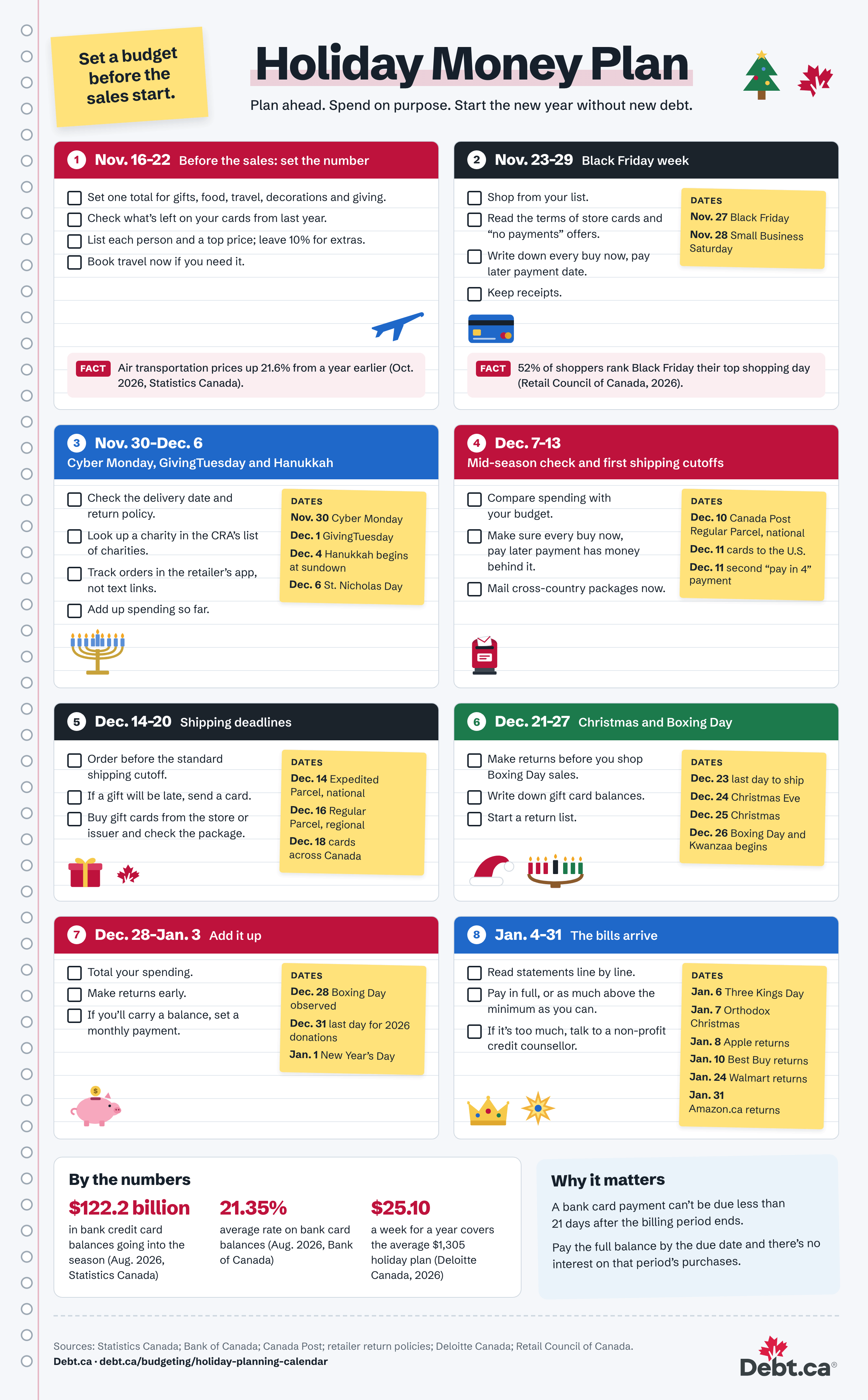
Each week has one job; select a week to open it. The early weeks set limits before the sales start, the middle weeks keep spending inside them and get packages out the door, and the January weeks deal with whatever ended up on a card.
Before the sales: set the number
- Pick one total for gifts, food, travel, decorations and giving. Write it down.
- Check what is still on your cards from last year. Any balance left is part of this year's holiday cost.
- List each person and a top price for each gift. Leave 10% for the things people forget, like wrapping, shipping and hosting.
- Decide how you will pay: cash or debit for most of it, or a card you will pay in full in January.
- If you're travelling, book now and put fares, bags, gas and lodging in the same budget. Air transportation prices were up 21.6% from a year earlier in October (Statistics Canada).
Why now: deciding before the flyers and ads start makes it easier to say no to a deal you didn't plan for. See holiday shopping: how much is too much?
Black Friday week
- Nov. 27 Black Friday
- Nov. 28 Small Business Saturday
- Shop from the list. A discount on something you didn't plan to buy still adds to the total.
- Black Friday is shoppers' top day: 52% rank it first, and they expect it to take about 29% of their holiday budget (Retail Council of Canada).
- Be careful with a store credit card offered at the till. Read the rate and the terms of any "no payments" or deferred-interest offer before you sign.
- Before using buy now, pay later, write down every payment date and amount.
- Keep receipts (or photos of them) in one place for returns and price adjustments.
Cyber Monday, GivingTuesday and Hanukkah
- Nov. 30 Cyber Monday
- Dec. 1 GivingTuesday
- Dec. 4 Hanukkah begins at sundown
- Dec. 6 St. Nicholas Day
- Shoppers expect Cyber Monday and Cyber Week to take about as much of their budget as Black Friday (Retail Council of Canada). Count both in the same total.
- Check the delivery date and the return policy before you pay. Some sale items are final sale or have shorter return windows.
- Look up a charity in the Canada Revenue Agency's list of charities before you give, and give through the charity's own site.
- Expect package delivery texts. Track orders only through the retailer's or carrier's own site or app, not links in a text.
- Add up the first two weeks of spending. If you're over plan, cut the remaining list now, not in January.
Mid-season check and the first shipping cutoffs
- Dec. 10 Canada Post Regular Parcel, national
- Dec. 11 Cards and small packets to the U.S.
- Dec. 11 Second "pay in 4" payment
- Compare spending so far with your budget, including buy now, pay later plans and anything charged to a card.
- Make sure every buy now, pay later payment has money behind it, so a payment doesn't trigger an overdraft or NSF fee.
- Mail packages to the other side of the country now. Regular Parcel, the cheapest Canada Post option, closes first for national delivery.
Shipping deadlines
- Dec. 14 Expedited Parcel, national
- Dec. 16 Regular Parcel, regional
- Dec. 17 Xpresspost to the U.S.
- Dec. 18 Cards across Canada
- Order before the free or standard shipping cutoff. Express shipping after that can cost more than the discount saved.
- If a gift won't arrive in time, a card with a note about what's coming costs nothing extra.
- Buy gift cards from the store or the card issuer's own site. Check that the package hasn't been opened or the PIN scratched.
Christmas and Boxing Day
- Dec. 23 Last day to ship (Priority, overnight)
- Dec. 24 Christmas Eve
- Dec. 25 Christmas
- Dec. 26 Boxing Day; Kwanzaa begins
- Hold back from Boxing Day sales until you know what you're returning. Then use gift cards, or cash set aside for next year, on clearance decorations, wrapping and cards.
- Write down each gift card and its balance. Unused gift cards don't help your budget. See how to make the most of a Christmas gift card.
- Start a return list with the store, the deadline and whether the refund goes to a card or store credit.
Add it up
- Dec. 28 Boxing Day observed
- Dec. 31 Last day for 2026 donations
- Jan. 1 New Year's Day
- Total what you spent across cards, debit, cash and buy now, pay later. Compare it with the number you set in November.
- Make the returns. Refunds to a card lower the balance before the statement closes if you return early enough.
- If you'll carry a balance, decide now how much you'll pay each month and which debt to pay first.
The bills arrive
- Early January December statements arrive
- Jan. 6 Three Kings Day
- Jan. 7 Orthodox Christmas
- Jan. 8 Apple returns
- Jan. 10 Best Buy returns
- Jan. 24 Walmart returns
- Jan. 31 Amazon.ca returns
- If you celebrate Three Kings Day or Orthodox Christmas, set that money aside before the December statements are due.
- Read every statement line by line. Check that returns were credited and that no charge appears twice. Call your card issuer right away about anything you don't recognize.
- Pay in full if you can. If not, pay as much above the minimum as you can and stop using the card until it's paid off.
- If the total is more than you can pay in a few months, look at a lower-rate option, such as a balance transfer, or talk to a non-profit credit counsellor. See how to tackle holiday debt.
- Once the card is paid, start next year's holiday fund with a weekly transfer. Lunar New Year (Feb. 6) and Valentine's Day (Feb. 14) are the next gift-giving days.
Why it matters: a bank card payment can't be due less than 21 days after the billing period ends, and if you pay the full balance by the due date, there's no interest on that period's purchases. Miss that, and interest runs on the purchases.
Boxing Day and Boxing Week
Boxing Day is Saturday, Dec. 26 this year. Because it falls on a weekend, many workplaces give the day off on Monday, Dec. 28, and Canada Post and the major couriers are closed that Monday. Boxing Day is a general holiday under the Canada Labour Code for federally regulated workers, such as banks, airlines and telecoms, who get the working day before or after it off with pay when it falls on a day they don't normally work (s. 193(2)). It is also a public holiday in Ontario, where workers who don't normally work that day get a substitute day off with holiday pay under the Employment Standards Act, 2000. In the other provinces, check your provincial employment standards office.
Boxing Day sales now stretch into "Boxing Week," with many retailers running deals online and in store for several days after Dec. 26. Stores can also limit returns on Boxing Day itself: Best Buy, for example, won't take in-store returns on Dec. 26 (Dec. 27 in Quebec and Atlantic Canada). A sale that runs for a week takes away the reason to rush. Do your returns first, shop with gift cards and cash already set aside, and treat Boxing Week as the time to buy next year's wrapping and decorations at clearance prices.
Canada Post and courier holiday deadlines
Christmas falls on a Friday this year, so Wednesday, Dec. 23 is the last day to ship anything for delivery before Dec. 25. The deadline depends on how far the package travels as well as on the service: Regular Parcel across the country closes almost two weeks before Priority does. Each day you wait moves you to a faster, more expensive service, and rush shipping on a sale item can cost more than the discount saved.
| Canada Post service, within Canada | Local | Regional | National |
|---|---|---|---|
| Regular Parcel | Mon., Dec. 21 | Wed., Dec. 16 | Thu., Dec. 10 |
| Expedited Parcel and flat rate box | Tue., Dec. 22 | Fri., Dec. 18 | Mon., Dec. 14 |
| Xpresspost | Wed., Dec. 23 | Tue., Dec. 22 | Tue., Dec. 22 |
| Priority | Wed., Dec. 23 | Wed., Dec. 23 | Wed., Dec. 23 |
| Cards | Tue., Dec. 22 | Mon., Dec. 21 | Fri., Dec. 18 |
Source: Canada Post, Plan your holiday sending (October 2026). Recommended send-by dates for delivery before Dec. 25, between major urban centres; dates depend on origin and destination.
What it shows: Cross-country packages need to go out by Dec. 10 by Regular Parcel or Dec. 14 by Expedited Parcel. After that, only Xpresspost and Priority, the most expensive services, are left.
| Carrier, service and destination | Ship by |
|---|---|
| Canada Post, cards and Tracked or Small Packet to the U.S. | Fri., Dec. 11 |
| Canada Post, Expedited Parcel to the U.S. | Mon., Dec. 14 |
| Canada Post, Xpresspost to the U.S. | Thu., Dec. 17 |
| Canada Post, Small Packet and cards overseas | Dec. 3 to Dec. 11, by region |
| Canada Post, Xpresspost International | Dec. 10 to Dec. 15, by region |
| FedEx Ground, within Canada | Dec. 15 to Dec. 23, depending on the route |
| Purolator Ground to the U.S. | Tue., Dec. 15 |
| FedEx Economy, within Canada | Mon., Dec. 21 |
| FedEx 2Day, within Canada | Tue., Dec. 22 |
| FedEx overnight services; Purolator next-day, within Canada | Wed., Dec. 23 (Purolator advises Dec. 22 in case of weather) |
Sources: Canada Post, Plan your holiday sending (October 2026); FedEx Canada, 2026 Shipping Deadlines for Holiday Packages; Purolator, 2026 holiday send-by dates. FedEx dates are for most metro areas, for delivery by Dec. 24.
Canada Post, Purolator, UPS and FedEx are all closed on Christmas Day, Friday, Dec. 25, on Monday, Dec. 28, the day Boxing Day is observed this year, and on New Year's Day. UPS has no Saturday service on Dec. 26 and says its service guarantee is suspended for domestic shipments over the holidays. For items mailed Nov. 2 to Jan. 10, Canada Post pays late-delivery guarantee claims only when a Priority, Xpresspost or Expedited Parcel item arrives two or more business days late. Retailers set their own order cutoffs, often a few days before the carrier's, so check the store's shipping page too.
Holiday return deadlines
Some large retailers stretch their return windows for holiday purchases, so gifts bought in November can go back in January. The windows are not all the same, electronics close first, and some stores don't extend at all. Returning what you don't need is the fastest way to cut a holiday card balance: a refund to the card you paid with lowers what you owe, while store credit does not.
| Retailer | Holiday purchases made | Return by |
|---|---|---|
| Amazon.ca | Nov. 1 to Dec. 31 | Jan. 31 (Apple-brand products Jan. 15) |
| Walmart | Nov. 1 to Dec. 25 (unopened items with a 30-day window) | Jan. 24, with proof of purchase. Excludes items sold and shipped by Marketplace sellers and contract wireless devices. |
| Best Buy | Nov. 2 to Dec. 31 | Jan. 10, or the usual return period if later. Excludes phones and other cellular devices. No in-store returns on Dec. 26 (Dec. 27 in Quebec and Atlantic Canada). |
| Apple (online store) | Received Nov. 6 to Dec. 25 | Jan. 8 |
| Lululemon | Oct. 13 to Dec. 24 | Jan. 23 |
| Canadian Tire | No holiday extension | Usual policy: 90 days for unopened items with a receipt; 30 days for electronics; 14 days for auto electronics. Christmas and Halloween decor may have return limits. |
| Costco | No holiday extension | No deadline for most items; 90 days for TVs, computers, phones, tablets, cameras, smart watches and major appliances |
Sources: each retailer's 2026 holiday return page (Amazon.ca, Walmart Canada, Best Buy Canada, Apple Canada, Lululemon Canada) and the standard return policies of Canadian Tire and Costco Canada, read Nov. 11, 2026. Return-by dates are in January 2027. Exclusions apply; check the retailer's page for your item.
What it shows: Only Amazon.ca runs to Jan. 31. Apple and Best Buy close in the first 10 days of January, so make electronics returns first.
No law requires a store to take back an item that isn't defective, so the store's posted policy is what applies. Hudson's Bay closed its stores in 2025; Hudson's Bay-branded products now sold at Canadian Tire follow Canadian Tire's return policy. Keep receipts, packing slips and gift receipts together, and return unwanted items soon after the holidays. A refund that posts before your statement closes lowers the balance it shows, and the interest charged on it.
Paying for the holidays
A holiday isn't over until it's paid for. Write down every card charge and instalment plan as you go, so the bills that arrive afterward hold no surprises. For choosing how to pay in the first place, see how to make a holiday budget.
Track card and buy now, pay later payments
Printable payment trackers
| Card | Amount charged | Statement closes | Payment due | Amount you'll pay |
|---|---|---|---|---|
| $ | $ | |||
| $ | $ | |||
| $ | $ |
| Store or plan | Total | Each payment | Payment dates | Account charged |
|---|---|---|---|---|
| $ | $ | |||
| $ | $ | |||
| $ | $ |
Paying the full statement balance by the due date avoids interest on new purchases. Before each instalment date, check that the money is in the account the plan charges. A buy now, pay later plan isn't a discount; it's a claim on future paycheques.
How holiday spending shows up as debt
Holiday spending shows up in Statistics Canada's monthly credit data every year. Household credit card balances at the chartered banks rose $4.27 billion from October to December 2025, to $118.2 billion, then fell $4.33 billion in January 2026 as December statements were paid. The year before, they rose $3.38 billion and fell $4.68 billion; two years ago, they rose $3.89 billion and fell $3.29 billion. By August 2026, balances had reached $122.2 billion, a record, before this season's spending.
Source: Statistics Canada, Table 36-10-0639-01, Credit liabilities of households, credit cards at chartered banks (month-end balances, not seasonally adjusted; latest month August 2026). Changes calculated by Debt.ca.
What it shows: Balances jump in November and December, and January payments take them back down by about as much. But they climb again through the year: October balances rose from $101.3 billion in 2023 to $114.0 billion in 2025. The changes include all card spending and payments, not only holiday purchases, and cover cards issued by the chartered banks, not all lenders.
The January paydown looks complete, but it isn't the whole story. Many people pay December's statement by adding to another debt or by carrying part of it, and the total keeps rising year to year. Counting all lenders, Equifax Canada put credit card debt at $134.2 billion in the second quarter of 2026; 65% of consumers pay their card in full each month, so the rest carry a balance that charges interest.
Surveys of shoppers point the same way. In NerdWallet Canada's survey, 56% of people who shopped for the 2024 holidays took on credit card debt for them, and 28% of those were still paying it off in October 2025 (The Harris Poll, 1,017 adults, Oct. 20 to 23, 2025). After the 2025 holidays, only 19% said they were "not at all concerned" about paying their January card statements in full (Liaison Strategies, 1,000 adults, Jan. 2 to 10, 2026). For more on card debt, see credit card debt and how credit card debt affects your credit score.
Sources: Statistics Canada, Table 36-10-0639-01 (August 2026); Equifax Canada, Market Pulse, second quarter 2026 (Aug. 24, 2026); NerdWallet Canada, 2025 Canadian Holiday Spending Report (Nov. 25, 2025); Liaison Strategies (Jan. 15, 2026).
How long holiday debt takes to pay off
Interest is what turns a holiday balance into a spring or summer balance. The chart and table show $1,000 of holiday charges at 21.35%, the average interest rate on outstanding credit card balances at the chartered banks in August 2026 (Bank of Canada), with no new charges.
Source: Debt.ca calculation at 21.35% (Bank of Canada, average rate on outstanding chartered-bank credit card balances, August 2026), no new charges or fees.
What it shows: The red is the cost of waiting. A typical 3% minimum adds $1,109, more than the gifts cost, and takes more than 11 years.
| Monthly payment | Months to pay off | Total interest |
|---|---|---|
| Paid in full by the first due date | 1 | $0 |
| $250 | 5 | $47 |
| $200 | 6 | $57 |
| $100 | 12 | $111 |
| $50 | 25 | $247 |
| Quebec minimum (5% of the balance, at least $10) | 73 | $478 |
| Typical minimum elsewhere (3% of the balance, at least $10) | 137 | $1,109 |
Source: Debt.ca calculation. Interest compounds monthly at 21.35% (Bank of Canada, average rate on outstanding chartered-bank credit card balances, August 2026), with no new charges or fees. The 3% minimum is the typical formula described by the Financial Consumer Agency of Canada; card terms vary. Quebec's Consumer Protection Act requires a minimum payment of at least 5% of the balance (s. 126.1), which applies to all credit cards since Aug. 1, 2025. Many card agreements also set a $10 minimum, which this calculation uses.
What it shows: Paying a 3% minimum on $1,000 takes more than 11 years and costs more in interest than the gifts cost. Paying $100 a month clears it in a year for $111.
Your statement shows how long the minimum payment would take for your own balance. See why paying the minimum on your credit card does so little and try Debt.ca's credit card debt calculator. If you'll need more than a few months, a balance transfer with a low introductory rate can cut the interest, as long as you pay it off before the rate ends and count the transfer fee. You can also ask your card issuer for a lower rate.
Buy now, pay later at the holidays
Buy now, pay later splits a purchase into instalments, often four payments two weeks apart with no interest. In NerdWallet Canada's 2025 survey, 12% of shoppers planned to use it for holiday gifts, up from 9% in 2023. No federal agency has published a national measure of buy now, pay later use or late payments since the Financial Consumer Agency of Canada's small pilot study (2019 to 2021). In that study, 44% of repeat users had two or more plans with payments due at the same time, and 39% of users said they used it because they couldn't afford the whole purchase at once.
The risk at the holidays is stacking: several plans from different lenders, each charging on its own schedule, that are easy to lose track of. A pay-in-4 plan opened on Black Friday has payments due about Dec. 11, Dec. 25 and Jan. 8, the same weeks the December card statement arrives. Before using one, add every payment date to your calendar and keep the plans on one debit card or bank account that you check. See the risks of buy now, pay later.
Sources: NerdWallet Canada, 2025 Canadian Holiday Spending Report (The Harris Poll, 1,017 adults, Oct. 20 to 23, 2025); Financial Consumer Agency of Canada, Pilot Study: Buy Now, Pay Later Services in Canada (survey Sept. 2019 to March 2021; 66 users, which FCAC says should not be generalized to all Canadians).
Frequently asked questions
When is Black Friday in Canada this year?
Black Friday is Friday, Nov. 27, 2026, the day after U.S. Thanksgiving. It's a sale day, not a statutory holiday. Cyber Monday is Nov. 30 and GivingTuesday is Dec. 1.
When is Boxing Day, and is it a statutory holiday?
Boxing Day is Saturday, Dec. 26, 2026. It's a general holiday for federally regulated workers and a public holiday in Ontario; because it falls on a Saturday this year, many workplaces give Monday, Dec. 28 off, and Canada Post and the major couriers are closed that day. In other provinces it isn't a general holiday under employment standards law, so whether you get the day off depends on your employer.
When do I have to mail gifts to arrive by Christmas?
It depends on distance and service. With Canada Post, cross-country packages need to go by Dec. 10 by Regular Parcel or Dec. 14 by Expedited Parcel; Xpresspost runs to Dec. 22 and Priority to Dec. 23. Cards across Canada should go by Dec. 18, and cards to the U.S. by Dec. 11.
How long do I have to return holiday gifts?
It depends on the store. Amazon.ca takes most holiday purchases back until Jan. 31, 2027, Walmart until Jan. 24 for unopened items, Best Buy until Jan. 10 and Apple until Jan. 8. Canadian Tire and Costco keep their usual policies. No law requires a store to take back an item that isn't defective, so the store's policy is what counts.
How much should I save each week for Christmas?
Divide what you plan to spend by the weeks left. Shoppers plan to spend an average of $1,305 this season (Deloitte Canada, 2026), which is $25.10 a week over a full year or $50.19 a paycheque if you're paid every two weeks.
When should I start saving for a holiday?
About 10 weeks ahead works for one-day holidays: a $200 Valentine's Day or Mother's Day budget is $20 a week over 10 weeks. For the winter holidays, start right after the season ends; $1,305 over 47 weeks is $27.77 a week.
How much should I budget for birthdays?
Add up a gift limit for each person you buy for, plus any party you host, and divide by 52. Eight birthdays at $40 each is $320 a year, or $6.15 a week.
When will my holiday credit card bill come due?
It depends on your statement date. Purchases made after one statement closes appear on the next one. A bank must give you at least 21 days after the billing period ends to pay, with no interest on that period's purchases if you pay the full balance by the due date, so most December spending comes due in January or early February. Your statement shows the dates.
How many people go into debt for the holidays?
No government survey measures holiday debt directly. Statistics Canada's data show bank credit card balances rising $4.3 billion from October to December 2025. In NerdWallet Canada's survey, 56% of people who shopped for the 2024 holidays took on credit card debt for them, and 28% of those were still paying it off in October 2025.
What should I do if I already overspent?
Stop adding to the card, return what you can while the return window is open, and pay more than the minimum each month. List every balance with its rate and pay the highest rate first. If the total is more than you can pay off in a year, a non-profit credit counsellor can review your options. See coping with Christmas while in debt.
Methodology and sources
Winter holiday dates are for the 2026 season; year-round holiday dates are the next occurrence, in 2027. All amounts are in Canadian dollars. Shipping deadlines come from each carrier's published holiday schedule and return deadlines from each retailer's published holiday return policy, both as of the update date; they can change, so check the carrier's or retailer's own page before you rely on one. Credit card balance changes are differences between month-end balances in Statistics Canada's not seasonally adjusted series for household credit cards at the chartered banks, which doesn't include other card issuers. The payoff and savings tables are Debt.ca calculations: payoffs at the Bank of Canada's average rate on outstanding bank credit card balances, and savings as planned spending divided by the number of paycheques or weeks, before interest. Spending figures are averages among the people each survey asked and measure different things: Deloitte's covers gifts, entertaining and experiences, the Retail Council of Canada's holiday shopping only, and Moneris's are changes in card transactions, not amounts per person. Price changes are 12-month changes in the Consumer Price Index. The 21-day minimum before a bank card payment is due and the interest-free period on purchases paid in full are in the Bank Act, s. 627.34(2) and (4); Quebec's 5% minimum payment is in its Consumer Protection Act, s. 126.1; Boxing Day rules are in the Canada Labour Code, s. 193(2), and Ontario's Employment Standards Act, 2000.
Sources: Statistics Canada, Table 36-10-0639-01, Credit liabilities of households (August 2026), and Consumer Price Index, October 2026 (Nov. 16, 2026); Bank of Canada, Banking and Financial Statistics, interest rates for existing lending by chartered banks (August 2026); Equifax Canada, Market Pulse, Q2 2026; Financial Consumer Agency of Canada, Paying off your credit card, and Pilot Study: Buy Now, Pay Later Services in Canada; Office de la protection du consommateur (Quebec), minimum payment; Canada Post, Plan your holiday sending (October 2026) and peak-season customer notice (Sept. 2, 2026); Purolator, UPS Canada and FedEx Canada 2026 holiday schedules; Amazon.ca, Walmart Canada, Best Buy Canada, Apple Canada, Lululemon Canada, Canadian Tire and Costco Canada return policies; Hebcal; timeanddate.com; CanadaHelps; Canadian Federation of Independent Business; Deloitte Canada, 2026 Holiday Retail Outlook (Oct. 14, 2026); Retail Council of Canada and Leger, 2026 Holiday Shopping Survey (Oct. 20, 2026); Retail Council of Canada and Caddle, back to school (July 27, 2026); Moneris Data Services (Dec. 11, 2025, and March 2, 2026); Leger (Halloween, October 2025); NerdWallet Canada, 2025 Canadian Holiday Spending Report (Nov. 25, 2025); Liaison Strategies (Jan. 15, 2026).
Next update: before the next holiday season, with new carrier and retailer dates, and after Statistics Canada's January 2027 credit data show how this season's balances changed.
Cite this page
Debt.ca, “Holiday Planning Calendar: When to Save, Shop and Pay for Every Holiday,” Q4 2026 update. https://www.debt.ca/budgeting/holiday-planning-calendar